


New wooded trails are being constructed in Devou Park
The city of Covington has paved the way to bring more dedicated trails to a major Northern Kentucky park, which some hope will lead to greater connection of the surrounding communities.
Devou Park is undergoing a transformation with the installation and development of natural surface biking and hiking trails throughout the park, allowing visitors to get more use out of the park.
“It was always one of those places where it’s just so many acres, and so large, and people weren’t even aware how big Devou Park was,” Jason Reser, the trail development director for Cincinnati Off-Road Alliance (CORA), says. “So we opened that up, went through countless city and planning meetings and had a trail system planned. City council said, ‘Go ahead and do it,’ and so we just started building.”
The park, which offers panoramic views of the Ohio River and Cincinnati, is partly made up of an enormous tract of wooded, hilly terrain on the west side of the park, where the newly constructed trails are being developed.
This chunk of land already had a sparse amount of unofficial natural walking paths, cut out from years of hikers and bikers, that were not maintained, leading to trail erosion and overgrown brush.
“They weren’t necessarily sustainable, you go along and then all of a sudden there’d be a swamp or it’s rutted out. There would basically be a big ditch going down the hill,” says Reser.
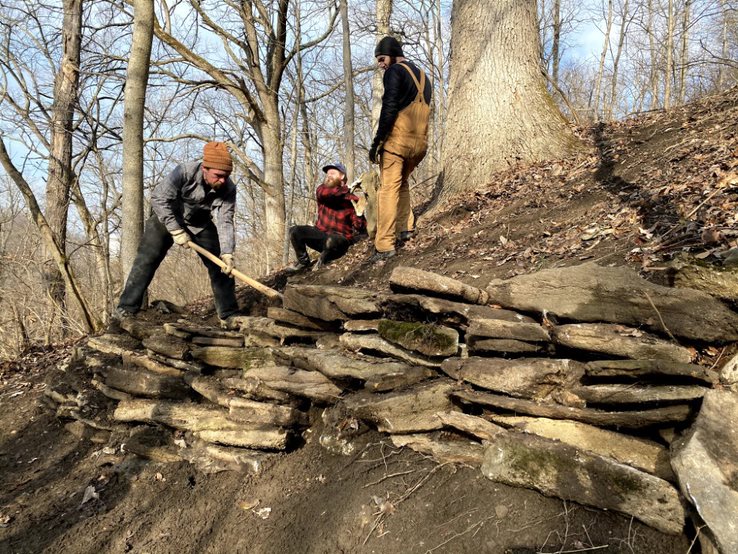
The new trails are to remain natural surface, with stones and gravel, and the tread has also been compacted with a tamper. These steps allow the rain to run off and keep the trail dry, providing a much sturdier, more sustainable and level pathway for visitors to use.
“The idea is we want to build sustainable trails so that they are built in such a way when people use them they don’t cause erosion and get washed out. They can be there for generations,” says Reser. “It’s an art form, but it’s also engineering.”
The newly constructed trails are the result of a partnership between the city of Covington and CORA, with financing through grants and donations.
Volunteers and adequate funding are a big part of the equation as the trail construction is a time-consuming process. Reser says that to remove a mile of invasive species such as honeysuckle by hand can take up to 2,000 hours. However, paying a professional to do this could cost as much as $20,000 per mile.
According to Reser, the benefits outweigh the costs as he envisions the trails not only providing recreation to park visitors but acting as a thoroughfare from one surrounding neighborhood to another, ultimately better connecting residents.
“If we can make these neighborhood connections, to Ludlow, to Fort Wright, to Covington, to Park Hills, and make them more accessible to residents nearby,” says Reser, “it’s going to make a huge difference in the health of the community.”
