

From Economy to West Covington to Botany Hills
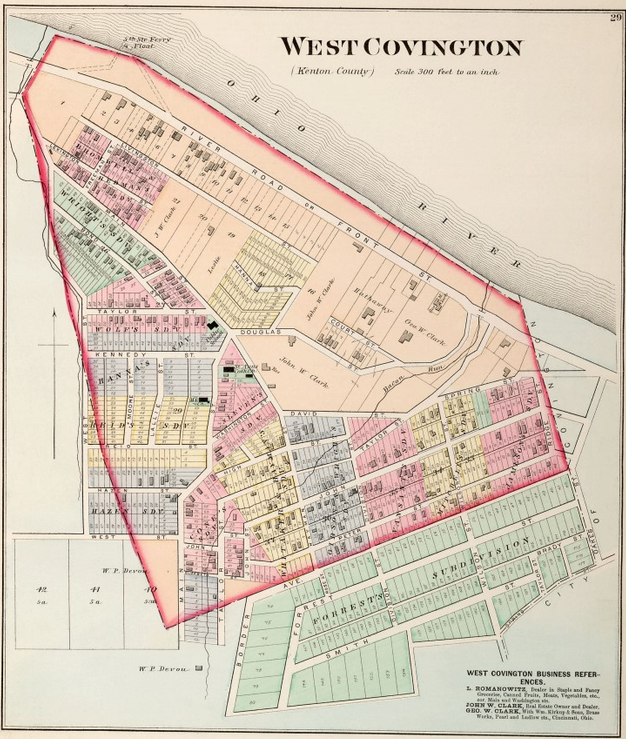
When people hear the words West Covington, they typically think of Covington’s West end neighborhood or the Mainstrasse area. However, West Covington was an independent city that existed from the 1840s until its annexation to Covington in 1916. Today’s West Covington, sometimes referred to as Botany Hills, sits on a hilltop between Crescent Avenue and the city of Ludlow along the Ohio River.
The neighborhood at one time was part of the Israel Ludlow estate. Ludlow owned Elmwood Hall (still standing in the city of Ludlow) and the surrounding thousand acres. Over time, land was sold by the Ludlow family. In the hilly east part of the property near Covington, a little village of modest frame homes began to develop. Local newspapers referred to the area as Economy, due to the frugality of the residents. As the community grew, the need for local government became apparent. Residents requested the incorporation of the village as the city of West Covington in 1858. This request was approved by the Kentucky General Assembly that same year. City government included five trustees, a police judge and a town marshal.
The city’s residents were staunchly pro-Union during the Civil War. A company was formed in the town and the city bought the volunteers uniforms. This company participated in the building of the fortifications to protect the region from Confederate invasion in 1862.
Following the war, the community’s population nearly doubled with an influx of immigrants from western Europe. By 1875, more than a thousand people called West Covington home. Many of these early residents were immigrants from England, Scotland, Germany and especially Ireland. The Irish were such a force in the community that some newspapers simply referred to the area as Hibernia.
A public school was established in 1858. In 1869, the city charter was amended to provide for a school board of five members. The school was for elementary grades only and was located on Main Street (now Parkway Avenue). By 1875, enrollment had reached 100 and was being taught by two teachers. In 1876, a new brick schoolhouse rose on the site of the original structure.
The Catholic members of the community also operated an elementary school in the city. St. Ann Church was dedicated on December 11, 1864. A few years later, a two-story frame school building was constructed, which housed 150 students by 1875. The school was originally taught by the Sisters of St. Francis of Oldenburg, Indiana. They were later replaced by the Sisters of Divine Providence in 1891. Other churches in the community included Union Methodist Episcopal Church (later Epworth Methodist), which was established in 1877, and St. John German Evangelical Church (now St. John Congregational Church), established in 1892.

Additional development occurred in 1893 with the construction of Highway Avenue between Covington and Ludlow. The new road cut a path directly through West Covington and resulted in the realignment of many of the city’s streets. Streetcar service was installed along the new avenue. For the first time, residents of West Covington had convenient and reliable public transportation to Ludlow, Covington and Cincinnati. As a result, new homes and businesses were constructed and the population increased.
West Covington was a landlocked community with no opportunities for expansion. The city was almost exclusively residential and relied almost entirely on property taxes. In the years before World War I, a number of residents began a campaign to merge with neighboring Covington. Covington offered services including a professional fire department, police department and a full public-school curriculum, including high school classes. All of these services would be gained at a lower tax rate. In November 1916, the residents of West Covington went to the polls and voted in favor of annexation to Covington. The city was no more. As a result, many of the street names in the community were changed so that they would not conflict with already existing streets in Covington. As an example, Main Street in West Covington became Parkway Avenue.
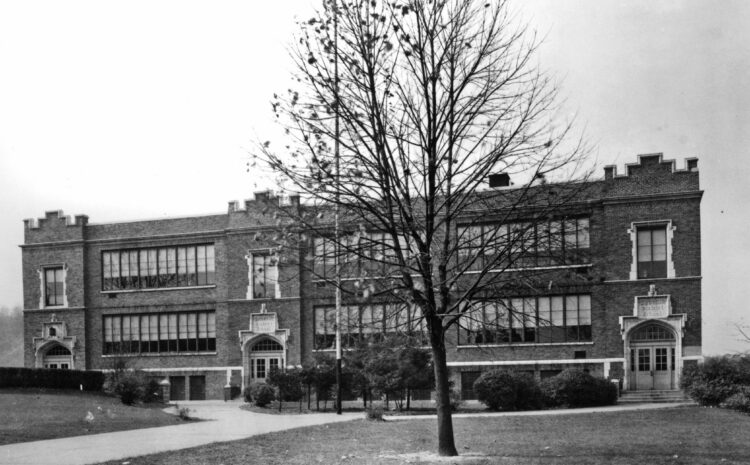
Annexation proved quite beneficial to the neighborhood. The West Covington school was renamed Eleventh District in 1916. A new school was constructed by the Covington School Board in 1919 on Parkway Avenue. Designed by the firm Richards, McCarty & Buford, the brick two-story building initially contained eight classrooms and was dedicated Sept. 23, 1923. West Covington architect Chester Disque designed an addition to the school, which was completed in 1931.
Other improvements in the neighborhood included a new Gothic Revival St. Ann Church, which was dedicated June 19, 1932. A new firehouse at the corner of Altamont and Parkway avenues followed in 1933. The new one-bay brick building was constructed at a cost of $10,000 and quickly became a favorite gathering place for the residents of the neighborhood. In 1953, Epworth United Methodist Church constructed a new $100,00 sanctuary on Highway Avenue. Finally, a new St. Ann School was constructed on Highway Avenue at the cost of $120,000. The school was dedicated Oct. 5, 1957.
The baby boom of the late 1940s and 1950s soon gave way to urban flight in the 1960s. The population of the neighborhood began to decline. The Covington School Board closed Eleventh District School in 1979. St. Ann Elementary survived two more years, closing in 1981.
Despite changing demographics, the community retains its small-town feel. The little neighborhood on the hill keeps moving forward and is beginning to see the impact of Covington’s recent urban renaissance.
By David E. Schroeder, executive director of the Kenton County Public Library
