

The developer’s fingerprints are all over Northern Kentucky
Jerome J. Weaver’s impact is all around us, yet few remember his name or achievements.
Residential development has been a constant theme in Northern Kentucky since the end of World War II. New subdivisions, parks and businesses have all shaped our communities in the post-war era. While current regional developers are well-known in our area, many earlier leaders in the field have been forgotten to time.
J.J. Weaver, as he liked to be called, was one of these. Weaver’s impact on the development of Ludlow, Devou Park, Crescent Springs and the Kenton Hills Neighborhood of Covington are substantial.
Laying the Groundwork
Weaver was born on April 21, 1862 in Davis, Illinois. He attended Northwestern University, where he earned a degree in engineering. Around 1890, Weaver accepted a position with the Southern Railroad and relocated to the bustling city of Ludlow, Kentucky. Here he began a career that spanned nearly 50 years.
A few years after his arrival in Northern Kentucky, Weaver married Audrey E. Coursey of Xenia, Ohio. He was elected city engineer of Ludlow, and in this capacity, planned the first telephone system and electric light plant in the city.
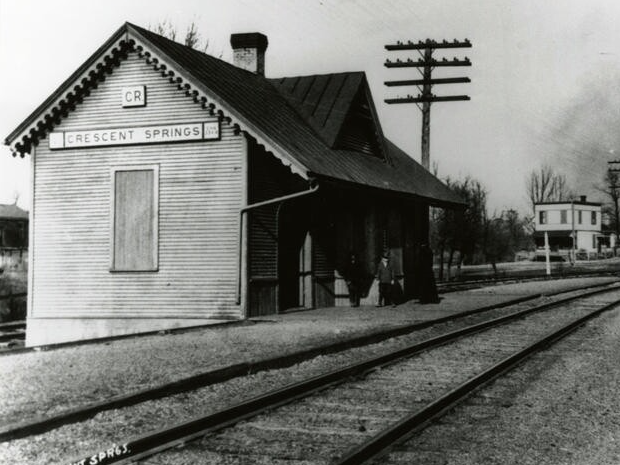
In 1893, a group of investors purchased a significant plot of land along the Southern Railroad in what is today Crescent Springs. They made plans to build a small rural city within easy commute distance from Cincinnati and Covington. Investors hired Weaver to lay out a new subdivision near the Crescent Springs Depot. From this small beginning, grew the current city we know today.
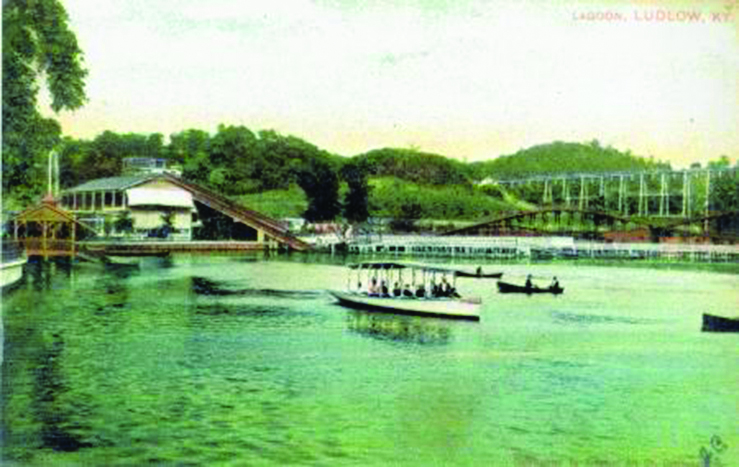
The year 1894 proved particularly profitable for the ambitious Weaver. One of his first duties as city engineer was to lay out Highway Avenue, which would connect Covington to the new Lagoon Amusement Park in Ludlow and provide a right-of-way for the Ludlow streetcar line. Weaver also surveyed the streets for a new subdivision north of Highway Avenue named Woodland Park. He named one of the streets Audrey in honor of his wife.
Building Up
Woodland Park quickly became a highly desirable residential neighborhood, which attracted many notable residents, including Weaver himself. Over time, Weaver became a shareholder in the Lagoon and, eventually, the general manager. Under his innovative administration, the park grew with new attractions and entertainment.
Tragedy struck the Weaver household on May 17, 1901, when Audrey Coursey Weaver died in childbirth. She was laid to rest three days later in Xenia, Ohio, in the family plot. Weaver would eventually remarry, having one son with Violet Gray.
Weaver also had his hand in the development of Covington’s Devou Park. In 1910, William and Charles Devou donated 500 acres of their family property to the city of Covington for a park. Weaver was contracted to design the main roads in the park. Weaver’s design called for winding paths and roads, which provided a much-needed green space for area residents living in the crowded urban core.
By 1913, Weaver and multiple partners were operating a new business named the Ideal Supplies Company on 35 acres of land in Ludlow. The property was initially mined for its large deposits of gravel. Eventually, Ideal Supplies became a concrete and building supply company that still exists today on Adela Avenue and is owned by the Gaiser family (since 1945).
Weaver’s Roaring Twenties—and Beyond
The 1920s proved to be a very busy decade for Weaver. In 1917 the Lagoon Amusement Park closed, and Weaver began developing the property into several subdivisions including the Lagoon Land Company (1905), the Lagoon Land Addition (1921) and the Ludlow Realty Subdivision (1922). Several hundred homes now sit on this property.
In 1924, Weaver announced plans for a new residential district adjacent to Devou Park containing 350 lots. He acquired the property from the Ludlow family and called the new community Kenton Hills. The model home for the subdivision opened on Labor Day weekend 1927. Advertisements explained that the neighborhood’s “values are as strong as the hills of old Kentucky. Nowhere can you find home sites of such great value. Kenton Hills is the only available subdivision with the Ohio River Valley as a river view.”
The Kenton Hills subdivision soon became a sought-after location for residential construction. Many of the early residents were Cincinnatians who chose the neighborhood for the sweeping river views and easy access to Devou Park. The area grew quickly and was incorporated as an independent city in 1962 to stave off its larger neighbor—Covington. Despite these efforts, Covington annexed Kenton Hills in 1965. At that time, the area included 71 acres and 225 residents.
Weaver did not live to see the completion of Kenton Hills. He died at his residence, 214 Lake St. in Ludlow, on August 12, 1939. He was 77 years old. Weaver was laid to rest next to his first wife Audrey Coursey Weaver at Woodland Cemetery in Xenia, Ohio. Weaver’s ambition and drive continue to live on today in his many developments and contributions to the region.
By David E. Schroeder, executive director of the Kenton County Public Library
Images: Kenton County Public Library
