

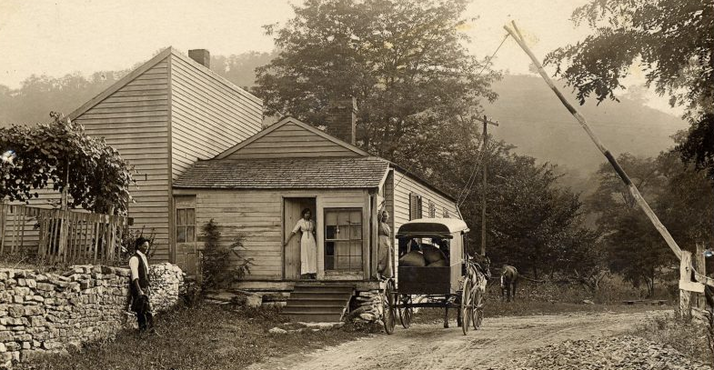
Northern Kentucky is teeming with many small communities. While some of these grew and reached city status, others remained barely more than crossroads featuring a few businesses, a church or two and a small cluster of houses. Constance, in Boone County near the Kenton County border, is one of these communities.
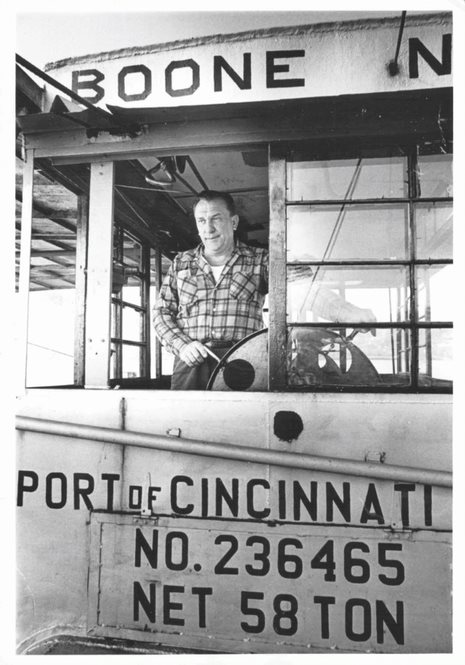
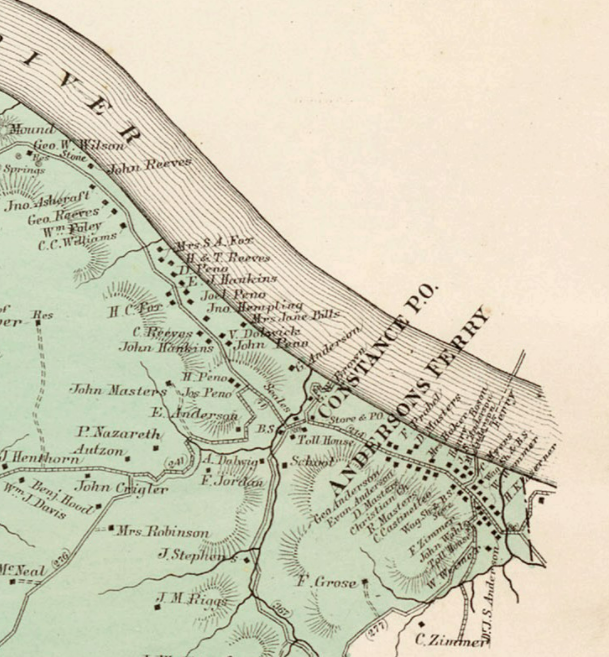
Constance is best known for its signature business, the Anderson Ferry. George Anderson began offering ferry services between the area and Ohio in 1817. Northern Kentucky was sparsely populated by farmers who needed to get their goods to the north shore of the river. At this time, no bridges existed linking the two states, so a ferry seemed like a good idea. The idea still lives on 204 years later! Today the Anderson Ferry continues to be a vital link between Northern Kentucky and Cincinnati and is listed on the National Register of Historic Places.
The Constance area benefitted greatly from its location along the Ohio River and the Dry Creek. The Dry Creek connected the community with central Kenton County and western Boone County. Both waterways allowed area farmers to ship their goods to the growing northern markets. Later, the completion of the Dry Creek Turnpike (current Route 8) linked Constance to Hebron to the west and Ludlow to the east. For many years, the turnpike was a toll road with gates near Constance.
George Anderson eventually sold the Anderson Ferry to George Kottmyer in 1864. The Kottmyer family still owns and operates the ferry today. This family has been active in the community for well over a century and once also operated a grocery. Their original fieldstone house stood near the ferry dock. It has since been replaced by a new home using some of the materials from the original.
In the years following the Civil War, the Constance community had grown to the point of needing a school. A one-room white clapboard schoolhouse was constructed in 1868 adject to the Kottmyer house. Two years later, the Constance Christian Church was established. A cemetery was also laid out on the southside of the Dry Creek Turnpike. It can still be visited today and contains gravesites dating backing to the 1800s. Some of the families laid to rest there include the names Anderson, Bell, Fox, Grimsley, Harbstreit, Hempfling, Prabel, Reeves, Tunning and Zimmer. More recently, local volunteers George Flowers and Robert Edwards have done considerable work to restore the cemetery and document its history.
By 1880, Constance was home to 133 residents. Several of the early families were German farmers and business owners. Some of these Germans founded the nearby Constance United Brethren Church. This became a gathering place for German Protestants living in eastern Boone County. German Catholics living in the area were among the founding members of St. Boniface Parish in Ludlow. No one knows for sure how the area received its name, but most agree it is an anglicized version of German city of Konstanz in Baden-Württemberg.
Another founding family in the community was Henry and Agnes Rolson (Rolfsen) who built a federal style, two-story home on what is today Dry Creek Road in 1840. The Rolsons were German immigrants who raised a large family in the house surrounded by farmland. They were early members of St. Boniface Parish in Ludlow and eventually moved to that city where they established a tin shop and hardware store. The home was listed on the National Register of Historic Places in 2005.
In time, Constance developed into a thriving little outpost between Hebron and Ludlow and retained close ties to both areas. The town included a grocery, butcher, blacksmith, shoemaker, wagon maker, a church and the school. The community was also home to a post office from 1853 until 1997 with the zip code of 41009.
A new Constance Elementary School was constructed in the 1920s. This building contained two rooms and necessitated the hiring of a second teacher. Eventually a third room was added. The little building was topped by a small cupola that became a landmark for those who worked on the river. Constance School closed in the 1970s.
In 1927, the Constance Christian church replaced the original building with a new concrete block and brick structure on the south side of Route 8. The building still stands, but the congregation has been disbanded.
Located along the Ohio River, Constance suffered from periodic flooding. The great flood of 1937 nearly destroyed the community. Water rose to the level of 15 feet in some areas, completing covering entire houses and businesses. Many of the residents found refuge with the Sisters of St. Benedict at Villa Madonna Academy in Villa Hills. Following the flood, some residents rebuilt while others decided to move away. This disaster eventually led to a slow and steady decline of the community. Small-scale farming ceased to be profitable resulting in many of those families leaving.
As the population of Constance declined, most of the businesses closed. However, many of the residents living along Route 8 remained. Their homes provide a rural atmosphere with sweepings river views while still having easy ferry and road access to larger nearby communities.
By David E. Schroeder, executive director of the Kenton County Public Library
