

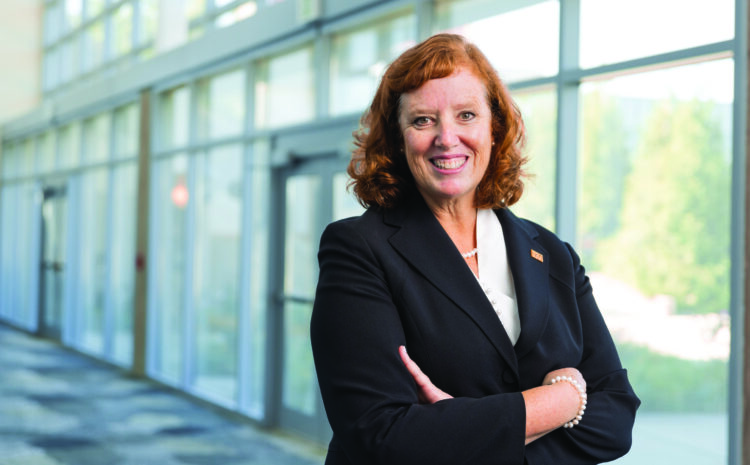
Dr. Cady Short-Thompson wants to “transform” the university
When Dr. Cady Short-Thompson was a young professional, many people told her she would become a university president. Some even told her she would become Northern Kentucky University’s president.
That dream eventually became reality, with Short-Thompson being selected as NKU’s seventh president in September. In her first week as president—officially starting in the role Oct. 2—Short-Thompson says her biggest achievement was meeting people and building a plan.
“We’re at the very beginning of building an enrollment management plan. There are a lot of different people that I’ve met with across campus and, just, listening to people and hearing their ideas and concerns and starting to put together a big puzzle of how we can grow our enrollments and be as strategic as we can about who we enroll in what programs—that sort of thing,” Short-Thompson says.
Having spent 14 years at NKU as a professor of communication and department chair from 1996-2010, Short-Thompson has been reacquainting herself with the campus, culture and people.
Goals for NKU
Short-Thompson’s No. 1 goal is enrollment management—evaluating who NKU serves, how NKU educates and in what ways.
“We’ve increased significantly in online delivery, but we also still are committed to in-person delivery. It’s really growing the whole number; It’s not one or the other. It’s both,” Short-Thompson says.
Short-Thompson says she will be spending a lot of time meeting with local superintendents and other regional leaders to strengthen the university and keep NKU at the “top of mind” for students.
Her other goals include ensuring NKU is well-equipped to go forward and build its way to being what the “region, state and country” needs it to be. Short-Thompson also wants to push NKU forward, creating a positive culture and climate.
“It’s kind of this combination of spending time dreaming out loud about who NKU needs to be for our prospective future students, as well as what we want this place to be like in a decade or 20 years,” Short-Thompson says. “I think we’ve got some strategic planning ahead over the horizon.”
Educational Equity
Student access is a “big passion” of Short-Thompson, who previously served as CEO for educational equity nonprofit Breakthrough Cincinnati. She says she learned about student access and the need for it during her time as an NKU faculty member. Short-Thompson is not a first-generation college student but her mom was.
“Her story stayed with me because I witnessed for myself what earning her own education and career meant to her and then I saw it in a lot of different ways as I taught different students from different backgrounds,” Short-Thompson says.
When a student is the first in their family to earn a college education, they set the example for siblings, cousins and parents.
“You never know who’s watching and learning from your example about the power of education and how it can help you to achieve whatever it is—your dreams, or what you’re good at doing—and a life that is built on that is pretty awesome,” says Short-Thompson.
Affordability and access go hand-in-hand, she says. One of the biggest barriers to students attending college is cost. Short-Thompson says students get a quality education for a good value at NKU, adding that NKU students have an average of a year and two months after graduation before they can pay off the cost of their education.
“My career … has always led me to conclude that we have to protect students from having exorbitant costs,” Short-Thompson says. “We always have to ask ourselves, ‘Is this good for students?’ And big price hikes are not going to be good for students.”
Being a Leader
Short-Thompson is the first woman to lead the university as president in a permanent capacity. Bonita Brown previously served as interim president from January to October of this year.
“I do think that sometimes, whether you intend to or not, people learn lessons from our example as a leader, period, whether we’re women or not,” Short-Thompson says. “I think that seeing another woman as a leader will have a legacy or a lasting impression.
Short-Thompson says there may be deans, chairs or other professionals at NKU who see her in this leadership role and realize it’s possible for them too. As a leader, Short-Thompson says she brings people from a variety of backgrounds “to the table.”
“There’s wisdom including a lot of different people. People think differently; they have different lived experiences. What I found over the years is that when I had a team that had different voices and faces and experiences, the work that we did was better because it was better informed,” Short-Thompson says. “And the people who we served were oftentimes represented by their voices and faces.”
NKU’s Future
Education has changed quite a bit in the last decade, Short-Thompson says. She thinks NKU has a real opportunity to “transform to what the region needs it to be” not just now but in the future.
“[It’s] also about making sure that we have our hands around what jobs and careers are needed and how can we best educate that workforce? I hope that [NKU] will be a place that’s healthy and vibrant, a place where students feel welcome and that they belong,” Short-Thompson says.
As NKU continues to grow, Short-Thompson says there are a number of questions to consider.
“We’ve grown more online and more graduate in the last few years. As we go forward, the question really, I think, needs to be what are the right programs? What are the right enrollment mixes? What are the right modalities, and then how can we make sure that everyone who comes here with a dream of an education and really meaningful career finds their way to that?
“I think we’re doing a really good job. I just look forward to connecting us to more corporations, more organizations, and, frankly, just increasing the resources so that we have more options to create the best possible environment for our students,” Short-Thompson says.
