

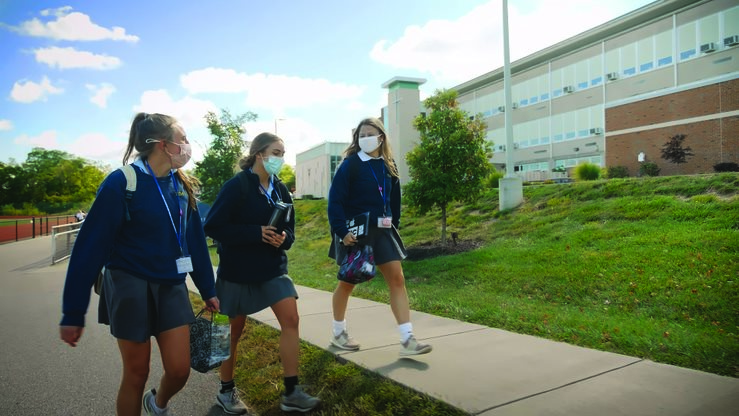
Notre Dame Academy has been able to provide in-person instruction for 90% of the school year
As the end of the school year approaches, Notre Dame Academy, an all-female Catholic college preparatory high school in Park Hills, is gearing up to celebrate an important milestone—it’s on track to have offered in-person classes for 90% of the 2020-2021 school year.
“Our experience with remote learning from last spring significantly drove our decision to make in-person instruction possible this school year. As successful as our Remote Learning @ NDA experience was in the spring of 2020, as educators we know that the educational experience of in-person learning is better for our students. Even with COVID-19 mitigation strategies in place, by sticking with in-person learning, we gained the sense of community that is so important to our students and their mental health,” says Principal Jack VonHandorf.
Over the summer, the school developed its Pandas Return to Campus Plan. The plan consisted of three scenarios—in-person classes with precautions, blended learning with both online and in-person classes and full remote learning. By having these plans in place, the school was easily able to pivot based on state guidelines or perceived risk. The school was able to quickly transition—Jane Kleier, chief communications officer for the school, points to their quick move from in-person to remote before Thanksgiving—and ended up never using the blended learning plan.
“Remaining flexible, adaptable and creative were essential to our success for in-person learning this year. We are a mission-driven school and our commitment to educating the young women at Notre Dame Academy remained at the forefront of our decision-making. Collaboration proved to be more important than ever this year, and students, parents, faculty, staff and volunteers all played a critical role in our success,” says VonHandorf.
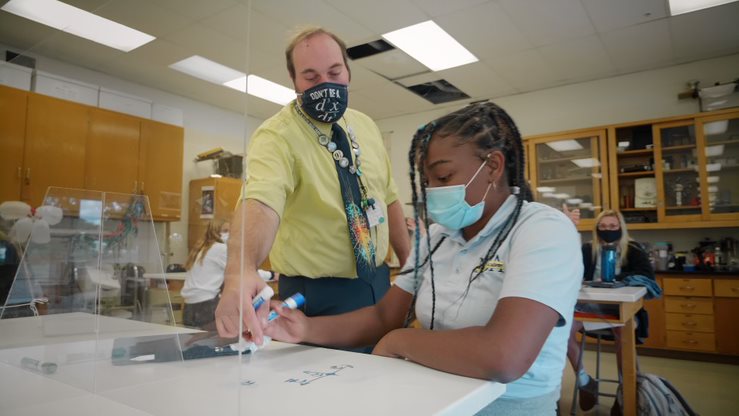
Kleier says that space was maximized in every classroom, getting as many students in as possibly while remaining 6 feet apart. If all students couldn’t fit in a class, a second auxiliary classroom was developed where the overflow students could receive instruction remotely. Plexiglass was installed when students couldn’t stay separated, such as in the cafeteria, and all students and faculty were asked to check in with an app each morning, answering questions to help the school know if they were experiencing any symptoms.
“It’s just been a huge time saver because we have a record of everybody who’s been in the building. So when we go to do contact tracing, if you were at an event, we can go back and take a look at that,” says Kleier.
The school also hired a nurse and two of its sisters were trained as contact tracers.
“We are so blessed not to have had spread on our campus,” says Kleier. “I keep hearing on the news, ‘Can you do it?’ You can do it, safely. We really can. We got great guidance from the state and put everything into practice. It does work—the masks, the social distancing, the hand-washing—those mitigation strategies really do work.”
