

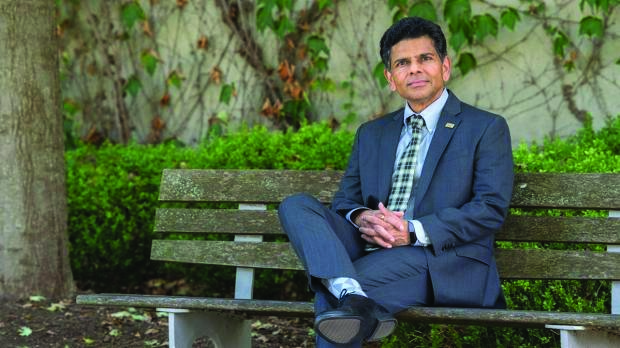
NKU President Ashish Vaidya on what it means to be a leader and how NKU continued to lead through the pandemic
A global pandemic didn’t stop Northern Kentucky University (NKU) from being a community leader. Even through virtual operations, NKU—and its president—remained dedicated to serving the region, taking the lead when it came to issues like COVID-19, the 2020 Election and more.
“I think what was important for us to do right away was to really build on the strong partnerships we already had,” NKU President Ashish Vaidya says of when the pandemic started impacting the region in March of last year.
Some of these partnerships included St. Elizabeth Healthcare, Gravity Diagnostics and the Northern Kentucky Health Department, which gave students access to COVID-19 testing and contact tracing. Vaidya says these partnerships were important because the COVID-19 pandemic was not something NKU could handle solely on its own.
Last summer, Vaidya says, NKU offered BB&T Arena as a 200-bed overflow hospital for COVID-19 patients. Before the renovation of the Honors House on NKU’s campus, the university offered it as a quarantine zone for community first responders so they could prevent potentially infecting their loved ones. The university also donated PPE and ventilators to local hospitals. Most recently, NKU partnered with St. Elizabeth to administer 4,000 Pfizer COVID-19 vaccines to community members at BB&T Arena. Vaidya says all the vaccine slots filled up within 24 hours
In addition to helping and serving the Northern Kentucky region medically during the pandemic, NKU and Vaidya also aimed to educate citizens on the 2020 General Election. NKU’s Scripps Howard Center for Civic Engagement worked with students, staff, faculty and community members to encourage people to vote.
“The work that [Scripps Howard] did with our students and the community in getting out the vote was, I think, remarkable,” Vaidya says. “I’m just so incredibly proud.”
NKU started election awareness and education with the freshman class by working with the orientation and enrollment offices to ensure all incoming freshman were given an NKU face mask with “NKU Vote” on it, as well as a postcard that listed voting information, such as how and where to register and how and where to vote.
NKU hosted community conversations around election security issues featuring College of Informatics faculty. The Northerner, NKU’s student-run news organization, collaborated with the Northern Kentucky Tribune to create an election guide that highlighted local, state and national races.
“We focused on our own student population—faculty and staff population—but, of course, it has ramifications for the entire community that the more we do this, the better off we’ll be,” Vaidya says. “And, of course, I think the proof was that this region, and citizens across the country, voted in record numbers.”
Vaidya says another important community aspect NKU dealt with last year was racial justice and the conversations surrounding the death of George Floyd.
“The Scripps Howard Center and many of our faculty and staff took the lead in really engaging with students and the community in conversations around racial justice and ways we should be thinking about this,” Vaidya says.
The Scripps Howard Center continued a community lecture series during the pandemic, even virtually. Some of these lectures, Vaidya says, included faculty expertise and research on Black history and culture. Scripps also worked with local K-12 educators to help their curriculum teach students Black history and the history of racism in the United States.
“It doesn’t start just in college,” Vaidya says. “We have to make sure that students in the K-12 are being exposed to how to best do this.”
Vaidya says NKU serves as a “steward of place” for the Northern Kentucky region. To Vaidya, it means that NKU’s work cannot be done without the context of the regional needs—business and industry, nonprofits, K-12 and more. The university’s relationships with local chambers, like the NKY Chamber of Commerce and the Cincinnati USA Regional Chamber of Commerce; educational institutions such as Gateway Community & Technical College; and local nonprofits are beneficial to both the school and the region.
“I was drawn to Northern Kentucky University because of its reputation as a regionally engaged institution,” Vaidya says. “It had set the model across the country for how universities need to respond to, engage with and support the economic, social and civic vitality of the region we serve.”
Vaidya says he’s been very blessed and fortunate to work directly with uplifting the region—whether it was from his time in Los Angeles to now in Northern Kentucky.
“What I’ve come to both appreciate is that state colleges and universities in those respective regions are making a difference, and it’s a symbiotic relationship between the region and the university,” Vaidya says.
As the nation and region come out of the pandemic, Vaidya says he wants NKU to continue to build on its foundation and successes. However, that also means fixing and enhancing any vulnerabilities or fissures that the pandemic exposed, Vaidya says, such as inequality. In the next five years, Vaidya is looking forward to NKU making tremendous progress in closing equity gaps across health, the economy, education and workforces.
“We’re not going to prosper as a region, frankly, as a nation or as a world if we leave large segments of the population behind; we’re just not gonna be able to do that. It’s a tremendous loss of human potential if we don’t focus on that aspect of the work,” Vaidya says.
Even though the pandemic caused a lot of disruption and difficulties, Vaidya says it’s only made him a better leader by making him realize that you never know your personal capacity and strength until you’re tested.
“I continue to grow and evolve in my leadership,” Vaidya says. “I don’t think you stop ever.”
As a leader, Vaidya says, there are times in movements of crises when you have to embrace your strength and not shy away from the situation. Leading with courage means you will make mistakes. Vaidya says he acknowledges mistakes he makes and grows and learns from them. As a leader, Vaidya says he’s privileged to experience it all—the good and the bad.
“I’ve said this multiple times, and I try and remind myself every day: ‘Don’t forget that you’re in this for purposes of service.’ And with that comes great reward, and I feel that every day,” Vaidya says.
