

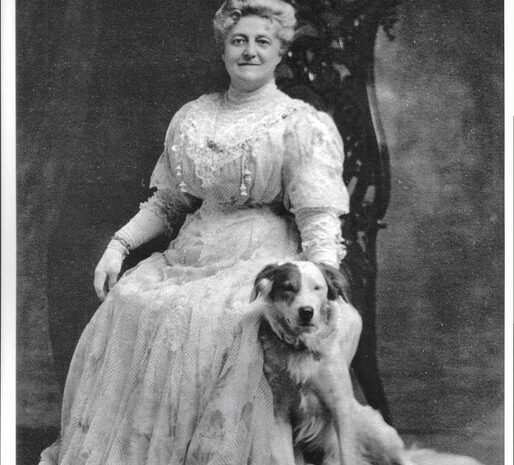
Margaretta Baker Hunt left a legacy for the arts in the region
By David E. Schroeder, executive director of the Kenton County Public Library
Northern Kentuckians are very familiar with the Baker Hunt Art and Cultural Center. However, relatively few know much about the woman who founded the organization and nurtured it into being.
Margaretta Baker was born on June 25, 1845, in Cincinnati. Her parents were John W. Baker, the owner of a candle and lamp store in the city, and Henrietta Adams Baker. The Bakers did quite well financially and when Henrietta was 10 years old, they moved to 620 Greenup St. in Covington.
Margaretta received her education in schools on the Cincinnati side of the Ohio River. Here, she also met her future husband, William Hunt. Hunt was a physician who studied at Jefferson Medical College in Philadelphia. The couple married on April 30, 1872, at Trinity Episcopal Church. Their only child was a daughter born the following year and was affectionately called Katie. Katie Hunt died of spinal meningitis on Jan. 14, 1888, on her 15th birthday. Margaretta and William memorialized the loss of Katie with a stained-glass window in the transept of Trinity Church and the construction of the building’s bell tower. Dr. John Hunt died on May 20, 1893. Before reaching the age of 50, Margaretta had lost her husband and only child.
Margaretta’s niece, Kate Scudder (1849-1926), moved in with the family in Covington in 1885. In many ways, Scudder could be considered a co-founder of Baker Hunt. Scudder not only provided comfort and companionship to Margaretta after her daughter and husband’s deaths, but she also encouraged her aunt to become even more involved in the community. Scudder’s involvement included working to establish playgrounds in Covington, as well as being a member of the Covington Art Club, the Daughters of the American Revolution, the Kenton County Historic Association, and the Kenton County Women’s Committee of the Council of Defense (World War I); an advocate for women’s right to vote; and the elected secretary of the Covington Public Library Board from 1912 until 1926.
Margaretta Baker Hunt opened her home to many cultural and religious groups in the Covington area. Margaretta even allowed the spacious grounds to be used for organized activities for the children of the neighborhood. During the 1920s, she began making plans to leave a permanent legacy to the people of Northern Kentucky. In the spring of 1922, she established the Baker Hunt Foundation. The main work of the foundation was to “promote the study of art, education and science and to promote the good works of religion in the Covington area.” This foundation continues to exist today and is a primary source of revenue for the Baker Hunt Art and Cultural Center. Among the other benefactors of Margaretta’s generosity during her life were the Girls Friendly Society of Trinity Episcopal Church, the Linden Grove Cemetery Memorial Association, the Covington Culture Club, the Covington Wildflower Preservation Association, the Covington Art Club and the Covington Weekday School of Religion Association.
In 1928, Margaretta Hunt agreed to accept as a gift the natural history collection of Archie J. Williams. This collection contained over 100,000 specimens of insects, butterflies, mammals, reptiles and birds. To house this collection, she hired architects Garber and Woodward to design a substantial building facing Sandford Street on her property. Margaretta herself placed the cornerstone on June 29, 1929.
Margaretta Baker Hunt quietly passed away on Aug. 11, 1930 at the age of 85. Funeral services were conducted at her home by the Reverend Lewis Burtin, the retired Episcopal Bishop of Lexington. Burial occurred at Spring Grove Cemetery in Cincinnati.
At the time of her death, most of Margaretta’s estate was left in trust to the Baker Hunt Foundation. In 1930, the first Board of Directors was chosen. These board members included Robert C. Simmons, Charles F. Warrington, Charles Smith, J.J. Rowe and William Coughlen. Since this time, Baker Hunt has become a center for arts education and community activities in Covington and Northern Kentucky, carrying on the legacy of one of Northern Kentucky’s most visionary philanthropists.

Today, Baker Hunt Art and Cultural Center continues to offer art classes to children and adults in many mediums, lectures, cooking classes, gardening programs and so much more. For nearly 90 years, Baker Hunt has carried on the mission that Margaretta Baker Hunt envisioned. In addition, the Baker Hunt house has been maintained and its architectural characteristics preserved. As time passed, the foundation also acquired the home just north of the Baker Hunt property that had once belonged to the Covington Art Club. This addition not only provided additional space, but also allowed the center to expand into other areas of cultural programming. The center’s museum-like setting and its surrounding gardens are an oasis of the arts and nature in the Licking-Riverside neighborhood of Covington and serve more than 10,000 residents each year.
