

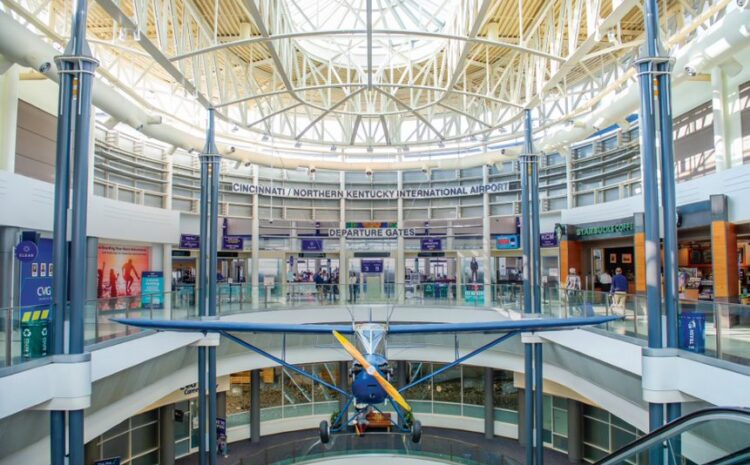
How CVG and CEO Candace McGraw have been able to successfully steer through the pandemic
In early 2020, the Cincinnati/Northern Kentucky International Airport was flying high—pun intended.
The airport, known by many as CVG for its International Air Transport Association identifier code, was processing more passengers than ever in its 74-year history. In 2019, 8.7 million local passengers passed through its gates (departing and arriving), up 4.8% from the year before and 35% higher than in 2005 during the Delta Air Lines/Comair Connection heyday, airport data show. The number of departing flights also was up—to 147, the most since 2012, although still way down from the peak of 639 in 2004. (Many connecting flights landed at CVG back then.)
2020 was on pace to beat 2019.
Then the COVID-19 pandemic hit. Hard. In early March 2020, the number of air travelers nationwide began a breathtaking plunge. The decline started March 2, and by March 16 U.S. passengers processed by the Transportation Security Administration fell to 51% of the volume on the same day of 2019, according to the TSA.
There was no parachute in sight, as passenger traffic didn’t bottom until exactly one month later at 3.6% of the previous year.
Candace McGraw, CEO of CVG since 2011, says she first heard about a disease originating in Asia during conversations in early 2020 with fellow members on the World Board of Airports Council International, a trade association. Then, in February, she attended the Airport Experience conference at which some large international vendors were talking about their Asian divisions and “the devastation to their business, and they wondered whether this will spread to the U.S.”
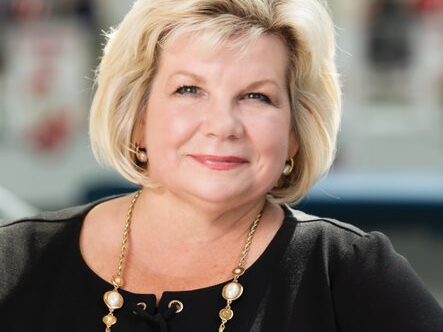
Spread, it did. The COVID-19 coronavirus came with a vengeance, forcing McGraw and her airport team into managing a pandemic not seen in 100 years—before commercial airports.
“Nobody could foresee it going so quickly,” McGraw says.
On a pure numbers basis, April 13 was the worst day for the airline industry, when just 87,534 people in the U.S. flew at a time when TSA usually processes 2 million to 2.5 million daily.
The airport—like all businesses—faced a crisis involving the 460 employees who work directly for the airport and 14,500 employees who work at the airport for 72 employers, ranging from passenger carriers to cargo carriers to concessionaires and other businesses. Complicating things was that 50% to 60% of those workers live in Kentucky, 30% to 40% live in Ohio, and the remainder come from Indiana, McGraw says. The percentages of the origins of travelers who come to CVG are reversed, with most travelers coming from Ohio.
With both workers and travelers, McGraw and her employees had to sort through three sets of state COVID-19 responses and restrictions, plus the federal rules and regulations.
“Thankfully, the federal government classified airport workers as essential workers,” she says. Before they did that, she issued a letter to employers on airport letterhead to give to their employees, showing that they worked at the airport. “We didn’t know if they were going to be stopped at state borders. So much of what we did early on was making sure that we could be operational.”
McGraw says airport industry groups approached the federal government to establish some uniform rules. For customers and airline and cargo crews, “the uniformity of rules was important for our industry.”
With passenger traffic falling quickly, “the uneasiness at the time was not knowing the depth and duration of the pandemic.”
Cargo carriers’ business began to take off, with people at their homes ordering everything from toilet paper to antibacterial wipes to computers online (remember empty grocery shelves?), along with the need to deliver PPE, or personal protective equipment.
CVG, recently named by London-based Skytrax as the World’s Best Regional Airport in North America in 2021, had learned its lesson after relying on a single airline—Delta—to drive so much of its business, as a hub, especially in the 1990s and early 2000s. Delta merged with Northwest Airlines in 2008 and moved the hub out of Cincinnati.
Soon after, McGraw, who grew up in Pittsburgh and graduated from University of Pittsburgh School of Law, joined CVG as chief administrative officer in 2009 after a number of positions at the Cleveland Airport System. She began working to attract more airlines and cargo business to CVG to add to its landing fees, parking, concessions and other revenue. The 7,700-acre airport now also leases more office, warehouse and other space to various businesses on the grounds.
At the onset of the pandemic, airports did not know that the federal government would provide three stimulus plans, so the relief revenue could not be projected. Congress eventually allotted $20 billion to the industry, including about $90 million for CVG, she says. Operating revenues fell 26% in 2020, compared with 2019, at CVG.
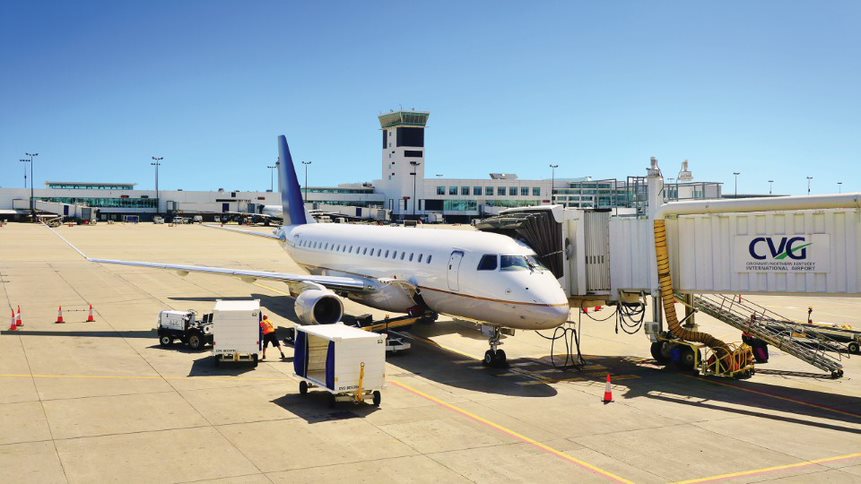
“The way we worked to diversify and recession-proof this business as much as we could was our saving grace during this pandemic,” she says. “Because we were so fiscally prudent during the worst of the pandemic, we are now in the enviable position of being able to use some of that [stimulus] money to benefit the business moving forward.”
Business travel was put on hold in 2019, for the most part. McGraw says she was concerned that more companies would employ videoconferencing when the pandemic ends, but that doesn’t seem to be the case.
A recent University of Cincinnati Economics Center survey found that most local companies plan to return to their 2019 levels of travel in 2022. McGraw says companies say they have employees ready to travel, but with so many businesses working remotely, employees aren’t available for meetings at the destinations.
“I’m hopeful that business travel will come back,” McGraw says. “International will be the slowest, until all of the various restrictions are lifted.” In mid-August, total U.S. passenger counts were at 75% to 80% of 2019 levels.
McGraw says aviation industry groups were critical for information—the world trade association provided updates, plus it scheduled calls among airport executives around the globe; nationally, the trade association scheduled weekly calls, especially for airports of similar sizes; and locally, she talked with executives at the Lexington and Louisville airports to discuss state-related issues and procedures, as well as meeting with her own leadership team to communicate what was going on at CVG.
“I remain forever appreciative of our team here, staying focused on how to deliver good service, how to keep our people safe and how to do it in the most economical way possible.”
McGraw says one life event impacted her view and response to the pandemic.
“I had a son who passed away in 2010—Luke—and that, of course, is the most devastating event that no one should ever have to experience,” she says. “It colors how I approach everything now, in that people always mattered to me previously, but relationships and people matter to me more now. It’s keenly important to me in the pandemic that people feel that I care about them personally.
“I wanted to make sure that they knew their job was going to be OK, they could pay their bills, they could focus on being safe and secure for their families.”
While it appears that the worst of the pandemic is past, COVID-19 cases began rising again in July and August. Still, McGraw says she’s confident that things will get back to normal.
“No one wants to stay in this uneasy state,” she says. “I’m glad that we have scientists and medical professionals and other folks trying to work their way through this.”
